


- May 6, 2026
- Posted by: EWGFX
- Category: news
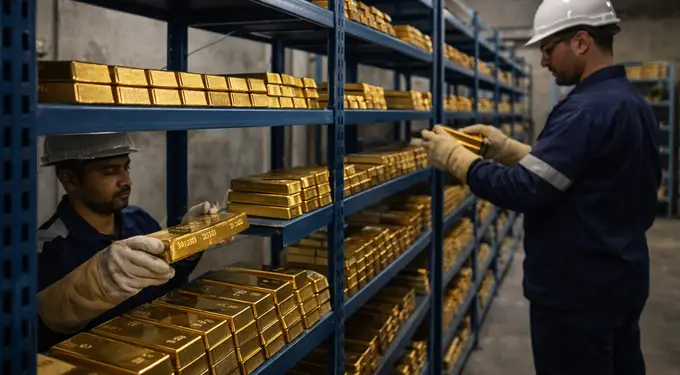
Gold jumps 2% on weaker dollar, Iran peace deal optimism.
Oil drop trims risk premium, fueling bullion’s sharp rebound.
Market eyes Fed policy, payrolls data for next gold driver.
Gold prices jumped nearly 2% on Wednesday on a weaker dollar against a basket of major currencies, and hopes for a US-Iran peace deal.
US President Donald Trump announced Tuesday that he would temporarily halt an operation dedicated to assisting ships through the Strait of Hormuz.
This decision, he stated, was made due to positive movement toward a broad agreement with Iran.
Gold prices rose as oil prices decreased. This drop in oil prices was attributed to a reduced “geopolitical risk premium,” according to Kelvin Wong, a senior market analyst at OANDA.
The reduction followed confirmation by the US that the fragile ceasefire with Iran remains in effect, despite a brief conflict earlier in the week.
At the time of writing, the COMEX gold contract was at $4,657.70 per ounce, up 2% from the previous close.
Geopolitical easing and currency impact
Following an indication from Trump that a peace agreement to end the war with Iran might be achievable, the US dollar and crude oil prices saw a decline.
This decline in the US currency makes dollar-denominated metals more affordable for investors holding other currencies.
Higher crude oil prices can fuel inflation, which in turn increases the probability of higher interest rates.
Although gold is typically seen as a hedge against inflation, high interest rates boost the attractiveness of assets that generate yield, diminishing gold’s appeal.
“The main downside risk is a stronger dollar or renewed Fed pushback on easing,” Manthey said.
Later this week, the US non-farm payrolls release is anticipated, with investors closely watching to see its implications for the Federal Reserve’s monetary policy.
The data will indicate whether the economy’s resilience is sufficient to maintain the current policy or if a softening labor market might necessitate a renewed consideration of rate cuts.
State of uncertainty
But, even as gold prices rose sharply on Wednesday, the market remains in a state of flux.
Since the start of the Iran war, the oil price has arguably been the key determinant of gold price movements.
Rising oil prices, suggesting higher inflation and tighter monetary policy, typically depress the price of gold due to increased opportunity costs.
The inverse correlation pattern was consistent over the last seven trading days, according to Commerzbank AG.
However, until Monday, the gold market’s price movements were increasingly subdued, suggesting a potential temporary equilibrium had been reached at $4,600 per ounce, Barbara Lambrecht, commodity analyst at the German bank said in a report.
The price of gold hit a one-month low, closing at just over $4,500 per ounce after dipping below $4,550 on Monday.
This decline was sparked by fears of rising interest rates, which were fueled by robust US orders and an increase in oil prices.
The next couple of sessions on Tuesday and Wednesday saw gold recovering from sharp losses, but the market remained nervous nonetheless about the yellow metal’s next move.
Meanwhile, despite central banks being net buyers in the first quarter, accumulating a total of 27 tonnes of gold, World Gold Council data revealed a shift in March, when they became net sellers with approximately 30 tonnes in net sales.
Among other precious metals, silver prices on COMEX rose 3.5% to $76.170 per ounce. The metal remained stuck in a broad range of $73-$80 per ounce.