


- June 2, 2026
- Posted by: EWGFX
- Category: Technical analysis
During the previous week’s market close, gold prices ended slightly higher. However, gold remained highly volatile and faced pressure from several factors, particularly persistent U.S. inflation, which supported higher U.S. Treasury yields and a stronger U.S. dollar. As a non-yielding asset, gold tends to come under pressure when interest-bearing assets become more attractive.
At the same time, the confirmation of a 60-day extension of the ceasefire agreement between the United States and Iran helped ease geopolitical concerns and improved overall market sentiment. This encouraged a risk-on environment, prompting some investors to shift funds from safe-haven assets such as gold into riskier assets, including equities, resulting in weaker demand for gold toward the end of the week.
For the coming week, the U.S. dollar and Treasury yields are expected to remain elevated or strengthen further if U.S. economic data continue to outperform market expectations. Strong economic indicators would reinforce expectations that the Federal Reserve may maintain higher interest rates for a longer period, which would likely remain a bearish factor for gold prices.
In addition, the easing of tensions between the United States and Iran following the ceasefire extension has reduced demand for safe-haven assets, limiting gold’s upside potential in the short term.
Nevertheless, gold has already undergone a significant correction from its yearly highs, attracting bargain-hunting and accumulation buying near key support levels. Furthermore, central banks around the world continue to increase their gold reserves, providing support for gold’s medium- to long-term outlook.
Should the U.S. dollar begin to weaken or geopolitical risks re-emerge, gold prices could stage a strong recovery and rebound significantly.
Technical Analysis
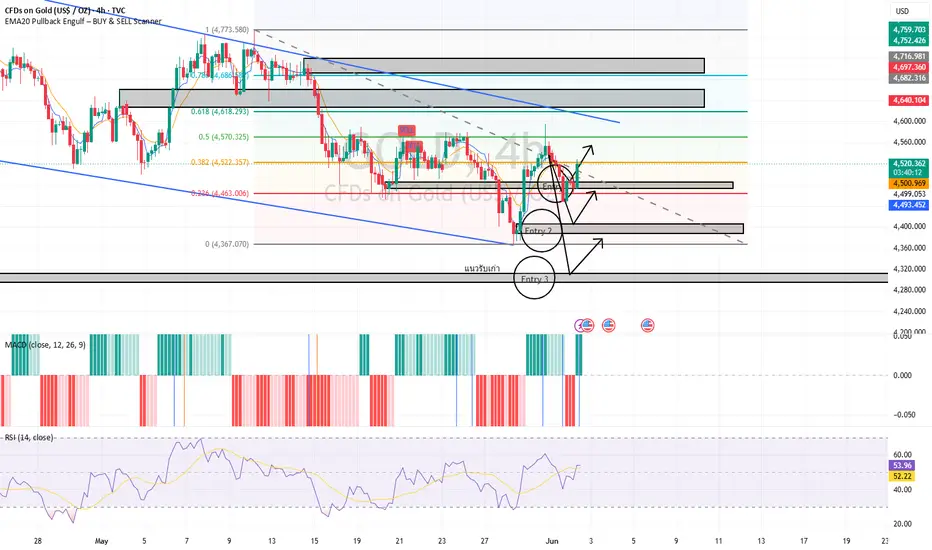
On the 4-hour timeframe, gold remains in a downtrend. However, several key U.S. economic releases scheduled for next week could significantly influence gold prices, including:
JOLTS Job Openings (June 2)
ADP Employment Change (June 3)
ISM Services PMI (June 3)
Initial Jobless Claims (June 4)
Nonfarm Payrolls (NFP) (June 5)
Unemployment Rate (June 5)
If U.S. economic and labor market data come in weaker than expected, markets may increase expectations for an earlier Federal Reserve rate cut. This could lead to a weaker U.S. dollar and lower Treasury yields, providing positive support for gold prices.
Additionally, any escalation in geopolitical tensions could increase safe-haven demand and support a rebound in gold, with prices potentially retesting the 4,680–4,760 area.
Risks
If upcoming U.S. economic data exceed market expectations, the U.S. dollar and Treasury yields could strengthen further, placing additional downward pressure on gold prices.
Meanwhile, the 60-day extension of the ceasefire agreement continues to reduce safe-haven demand, increasing the possibility of gold retracing toward the 4,407–4,366 support zone.
Target Prices
Short-Term Entry
Entry 1: 4,485
Take Profit: 4,617 / 4,672 (R ≈ 1:1.4 / 1:2.0)
Stop Loss: 4,389
Deep Support Entry
Entry 2: 4,406
Take Profit: 4,617 (R ≈ 1:2.0)
Stop Loss: 4,301
Crash Buy Entry
Entry 3: 4,311
Take Profit: 4,521 / 4,570 (R ≈ 1:1.9 / 1:2.3)
Stop Loss: 4,199