


- June 26, 2026
- Posted by: EWGFX
- Category: Technical analysis
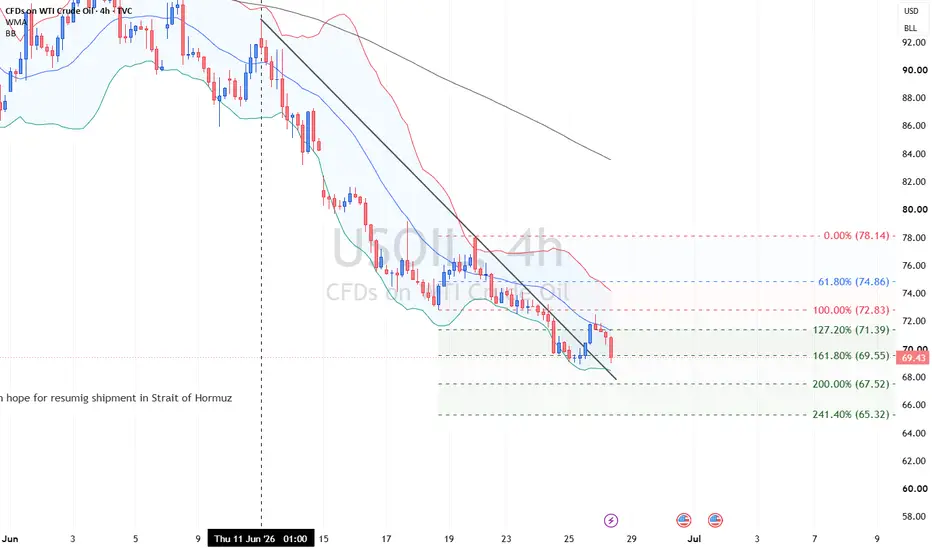
WTI is no longer just pricing the removal of the war premium. The first stage of the selloff was clear: improved tanker flows, lower Hormuz risk and resumed supply movement reduced the need to pay an energy-risk premium. But now that WTI is near $70.70, the market is asking a second question: is lower oil still good disinflation, or is it becoming a warning about weaker demand?
The chart shows that buyers tried to stabilize price from $68.90, but the rebound failed near $72.43. That failure matters because it shows sellers are still active on rallies. Price is back below the WMA near $72.97 and close to the Bollinger midline around $70.99. Immediate support is $69.46, then $68.90. Resistance is $71.08, followed by $72.43 and $73.52.
The macro read is two-sided. Lower oil helps inflation expectations and reduces pressure on consumers. But if oil keeps falling while equities also weaken, markets will stop treating it as a clean positive. It starts to look like a demand problem. That is why Baker Hughes data matters today. If rig activity stays firm while crude is already heavy, the market may read it as a supply-heavy backdrop, keeping pressure on oil.
If oil breaks below $68.90, the disinflation story becomes more negative for growth sentiment.